Our School Shadowing Programme provides personalised, in-school support to help children access learning, participate confidently, and thrive within their educational environment. Working closely with families, teachers, and school staff, our therapists implement individualised strategies that build on each child's strengths while supporting their unique learning, social, behavioural, and developmental needs.
Our goal is not to do things for the child, but to empower them with the skills and confidence to succeed independently. Through targeted support, collaborative planning, and a graduated approach that reduces assistance over time, we help children strengthen their communication, social interaction, emotional regulation, executive functioning, and classroom participation.
By fostering independence and meaningful inclusion, we support children in becoming active, confident, and capable learners both within the classroom and across the wider school community.
-
School Shadowing is suitable for children who require additional support to access the classroom, participate in school routines, or manage the academic, social, behavioural, or sensory demands of the school environment. Support is individualised and adapted to each child's strengths, goals, and level of independence.
-
Our therapists work alongside your child within the classroom to provide the right level of support while encouraging independence. This may include:
Supporting attention and engagement
Facilitating communication and social interactions
Assisting with classroom routines and transitions
Promoting emotional regulation and coping strategies
Encouraging independence with learning tasks
Supporting participation during lessons, recess, and school activities
Collaborating with teachers to implement effective strategies
-
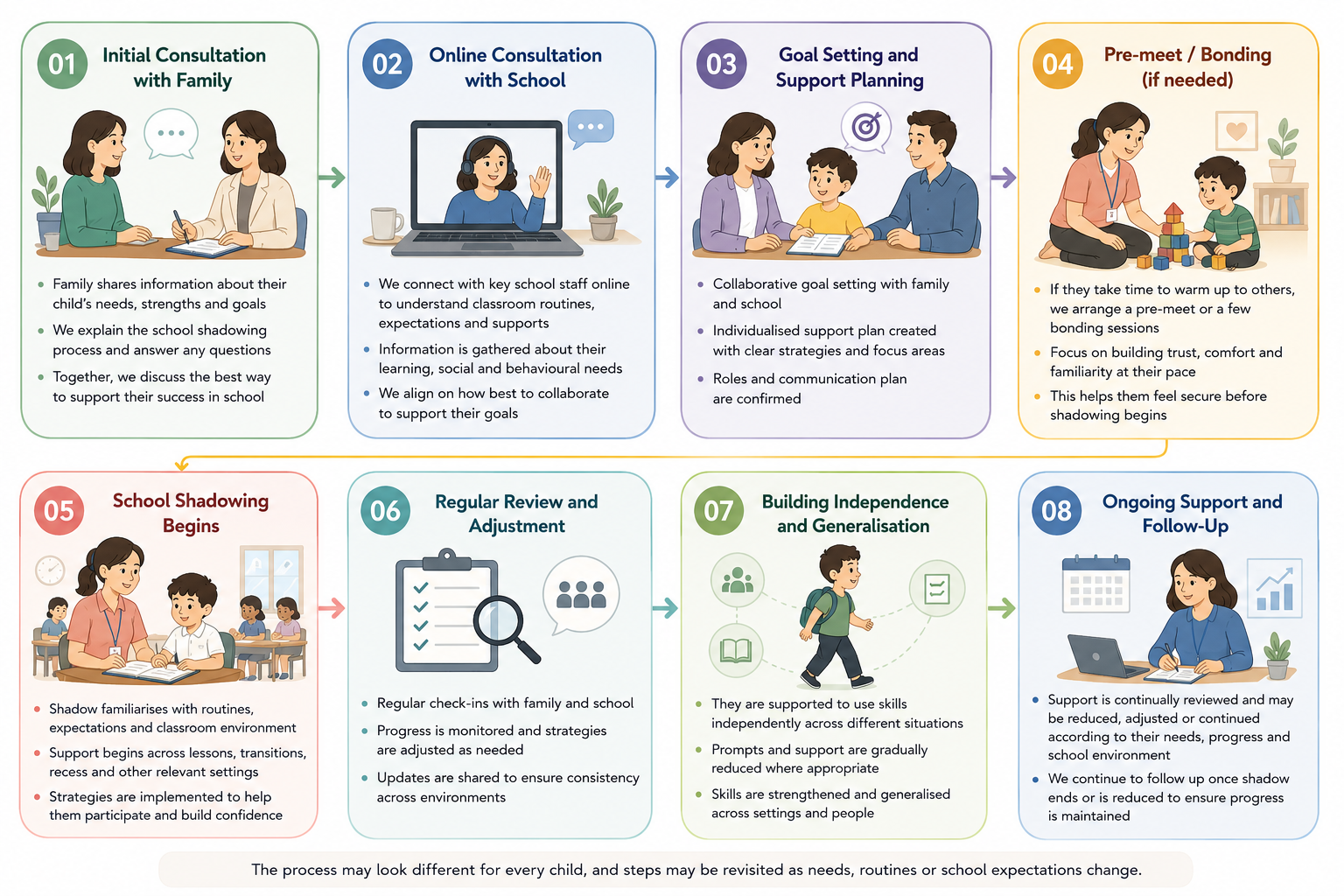
Support is individualised based on your child's needs and school environment. Our therapists use a graduated approach, providing only the level of assistance required and systematically reducing prompts as children develop greater confidence and independence. The goal is always to empower children to participate as independently as possible.
-
Support is continuously reviewed and tailored to each child's individual needs. As children develop greater independence, confidence, and self-management skills, support may be gradually adjusted to encourage increased autonomy where appropriate.
Every child's developmental journey is unique, and the level of support provided is guided by what will best enable them to participate meaningfully, learn successfully, and thrive within the school environment.
Any transitions are carefully planned in collaboration with families and schools, ensuring children continue to feel supported as they progress at their own pace.
-
Support is tailored to each child's goals and may focus on:
Classroom participation
Attention and learning behaviours
Communication and self-advocacy
Social interaction and friendship skills
Emotional regulation
Executive functioning and organisation
Independence with routines and tasks
Flexibility and problem-solving
Self-help and daily living skills
School readiness and confidence
-
Our therapists are not there to complete tasks for children or become a permanent support.
Instead, we provide the right support at the right time, gradually reducing assistance as children develop the confidence and skills to succeed independently.
Our ultimate goal is for every child to participate meaningfully and confidently in school with the least amount of support necessary.
Our process